


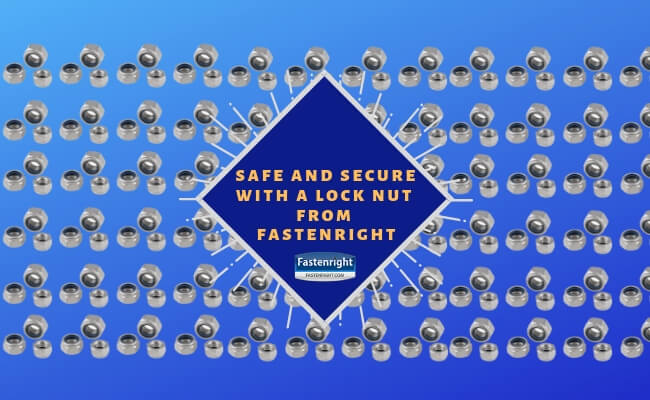
Lock Nuts are designed to lock in place during installation, creating a band of tight threads which act as a locking mechanism – ensuring the fastening of your application remains safe and secure.
Historically, designers would require nuts to be “double-nutted” which would ensure that an assembly did not come loose – which was an excellent way of preventing the assembly from loosening but in terms of cost-effectiveness, it pales in comparison to more modern techniques.
The more modern techniques were developed by nut manufacturers and designed to eliminate the need for double-nutting, and these were called lock nuts.
These nuts are usually a hex nut with a built-in feature that increases the resistance to loosening and is quite often referred to as “prevailing torque” lock nuts.
Exploring the Nylon Lock Nut
Nylon lock nuts are lock nuts that come with a nylon insert that can conform to the threads of the screw on which it is placed, allowing the nut to grip more flush with the thread and stopping the nut from loosening.
They are used across a number of industries, including computing, furniture, medical equipment, vehicles and more.
When used to secure wheels on an axel, the lock nut should be placed after a washer has been slid down the shaft – which prevents the nut from loosening due to friction from the wheel.
Due to the nylon insert, these lock nuts are not suitable in high-temperature applications or alongside some chemicals – but they do provide some kind of a sealant against moisture and gas.
We can also provide a flange head version,
What’s the use of a Lock Nut?
In the engineering trade, lock nuts are very useful. They are especially useful in holding wheels onto axels or within engines where the vibration of the engine would otherwise loosen the fastener of choice. Whilst there are a number of possible applications, it is used mostly in vehicles.
The lock nut fits the threads of the screw and causes gripping action due to the friction created, which lessens the chance of the nut coming loose. Although the name suggests that the tool actually locks, it does not – depending on the amount of vibration in the application that the lock nut is used for can have a relatively large impact on how easy the nut will loosen.
They can become loose, but they will not come apart due to the friction that “locks” the nut onto the thread.
Our Lock Nut Range at Fastenright
Available from stock at Fastenright.
Please give our experienced sales team a call, or use our enquiry form.